
Keyword research is the backbone of every successful SEO strategy. To do it like a pro in 2025, focus on search intent, AI-enhanced tools, and semantic keyword clusters. This guide breaks down how to find, evaluate, and apply keywords that actually drive organic traffic.
Here’s what you’ll learn:
- How to find profitable keywords with real search potential.
- How to understand search intent (so you match Google’s expectations).
- The exact steps professionals use to turn keyword data into content strategies.
By the end, you’ll have a complete framework to find, validate, and rank for the right keywords in 2025 and beyond.
Introduction to Keyword Research
Ever write a great article — and then… crickets?
That’s what happens when your content doesn’t target the right keywords.
Keyword research isn’t about guessing what people search for — it’s about knowing it. In this guide, we’ll walk step-by-step through the same keyword research process used by pro SEOs.
You’ll learn:
- How to uncover search intent.
- The difference between primary, secondary, and semantic keywords.
- And how to find easy-to-rank terms your competitors missed.
Let’s turn your content into a ranking machine
What Is Keyword Research?
Keyword research is the process of discovering and analyzing the terms people type into search engines to find information, products, or services.
It’s the starting point of every SEO campaign — because keywords tell you what your audience actually wants.
In Short: Keyword research = identifying what your audience searches → matching it with what you can offer → creating content that ranks.
Key Components:
- Search volume: how many people search for the term each month.
- Keyword difficulty (KD): how competitive the keyword is.
- Search intent: why the user is searching (to learn, compare, or buy).
- SERP features: special Google results like featured snippets, videos, and “People also ask.”
When done right, keyword research helps you:
- Drive targeted traffic
- Understand your audience
- Find untapped content opportunities
Why Keyword Research Matters?
Keyword research isn’t just about finding words — it’s about understanding your audience and speaking their language online. Whether you’re writing a blog, optimizing a YouTube video, or building an eCommerce category, the right keywords ensure your content reaches the people who actually need it.
Think of keyword research as market research for search engines — it tells you what your audience wants, how they ask for it, and how you can serve them better.
Today’s search landscape goes beyond simple keyword matching. With Google’s AI algorithms like BERT and Gemini, intent and context are more important than ever. That’s why professionals now rely on semantic search, topical clusters, and AI-assisted keyword tools to stay ahead.
3 Big Reasons It Still Matters:
- Intent optimization — It’s no longer about volume. It’s about matching intent.
- Semantic SEO — Google understands context, not just keywords.
- Competition insights — Knowing what your competitors rank for helps you find gaps.
Today’s best-performing SEO strategies combine traditional keyword data with user intent, semantic relationships, and content clusters.
Understanding the Keyword Ecosystem
To do keyword research like a pro, you must understand that not all keywords are equal. The keyword ecosystem includes:
- Primary Keywords: Core focus terms of your content (example: keyword research)
- Secondary Keywords: Supportive, related terms (example: keyword analysis, keyword strategy)
- Semantic Keywords: Contextually related concepts (example: SEO tools, content optimization)
- LSI Keywords: Latent semantic indexing terms that help search context (example: keyword ideas, keyword ranking)
- Intent-Based Keywords: Reflect user goals such as informational, transactional, or navigational (example: best keyword tools)
- Long-Tail Keywords: Specific, low-competition phrases (example: how to find low competition keywords)
- Voice Search Keywords: Conversational, natural queries (example: what’s the best way to do keyword research)
- Branded Keywords: Include brand names (example: Ahrefs keyword tool)
- Local Keywords: Geographically focused (example: keyword research agency in New york)
Types of Keywords You Should Know
Here are all the keyword types you should use in your strategy:
| Type | Description | Example |
|---|---|---|
| Primary | Main target keyword that defines your content’s topic. | keyword research |
| Secondary | Related but less competitive keywords to support your primary keyword and build topic depth. | keyword strategy, SEO keyword research |
| Long-tail | 3+ word phrases with clear intent. | how to do keyword research for blogs |
| Semantic | Contextually related phrases Google associates. | search term analysis, content intent |
| Intent-based | Categorized by user goal (Informational, Navigational, Commercial, Transactional). | Search intent now outweighs keyword density. Informational: what is keyword research Navigational: Ahrefs keyword explorer Transactional: best keyword research tool for SEO Commercial Investigation: compare Ahrefs vs SEMrush |
| LSI | Latent Semantic Indexing terms improving topic depth. | SEO optimization, ranking terms |
| Voice Search | Conversational queries (question-based). | what’s the best way to find keywords |
| Branded | Include brand names. | Ahrefs keyword research |
| Local | Include location modifiers. | keyword research agency in New York |
Pro Tip: Mix all of them naturally for a well-rounded content strategy.
Step-by-Step: How to Do Keyword Research Like a Pro
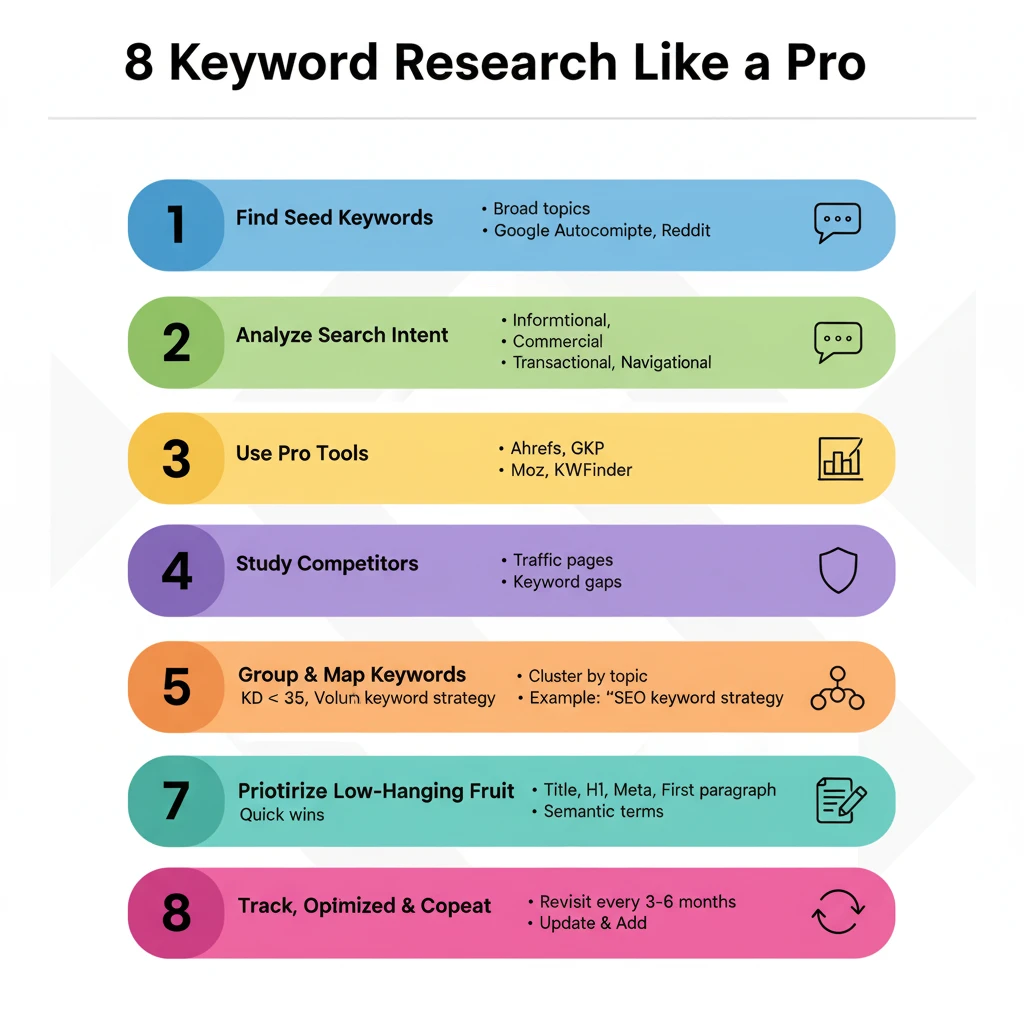
Step 1 — Find Your Seed Keywords: Identify Your Goals
Start with broad topics related to your business. Decide your objective: traffic, leads, or conversions. Use Google Autocomplete, Reddit, or Ahrefs’ Keyword Explorer. A keyword plan without direction leads to poor results.
Step 2 — Analyze Search Intent
Understand what the user really wants. List 5–10 key topics in your niche.
Example for SEO blogs: keyword tools, link building, ranking factors, site audits.
| Intent | Example Query | Best Content Type |
| Informational | how to do keyword research | Blog post |
| Commercial | best keyword tools 2025 | Comparison guide |
| Transactional | buy keyword tool | Landing page |
| Navigational | Moz keyword explorer | Tutorial |
Step 3 — Use Pro Keyword Tools
Find keyword ideas using trusted tools like
- Ahrefs Keyword Explorer — for volume & difficulty
- Google Keyword Planner — free baseline data
- Moz Explorer — SERP overview
- Mangools KWFinder — beginner-friendly UI
Step 4 — Study Your Competitors
Check your competitors’ top pages, keywords, and backlinks. Reverse-engineer what works for others. Use Ahrefs or SEMrush for analysis.
- Plug their URLs into Ahrefs or SEMrush.
- See which pages bring traffic.
- Spot keyword gaps.
Step 5 — Group and Map Keywords: Map Keywords to Content
Group related keywords under one main topic. Cluster by topic to improve topical authority.
- Main keyword: keyword research
- Subtopics: search intent, LSI keywords, keyword tools.
Example cluster: Keyword Research for Beginners
- keyword research tools
- SEO keyword strategy
- find long-tail keywords
Step 6 — Prioritize Low-Hanging Fruit
Focus on keywords with KD < 35 and volume > 200.
Quick wins build authority fast.
Step 7 — Create Optimized Content
Add the primary keyword in your title, H1, meta description, and first paragraph.
Sprinkle semantic and secondary terms naturally.
Step 8 — Track, Refresh & Repeat
Monitor rankings with Google Search Console or Ahrefs. Revisit your keyword list every 3–6 months. Update, remove, or add terms based on performance.
Read content refresh strategy Guide
Pro Tools for Keyword Research
| Tool | Key Feature | Ideal For |
| Ahrefs | KD + SERP insights | Advanced SEOs |
| Google Trends | Seasonal trends | Content planners |
| SEMrush | Intent clusters | Agencies |
| Mangools KWFinder | Easy UI | Beginners |
| Answer the Public | Voice search data | Bloggers |
| Moz Explorer | SERP analysis | Auditors |
Keyword Research Checklist
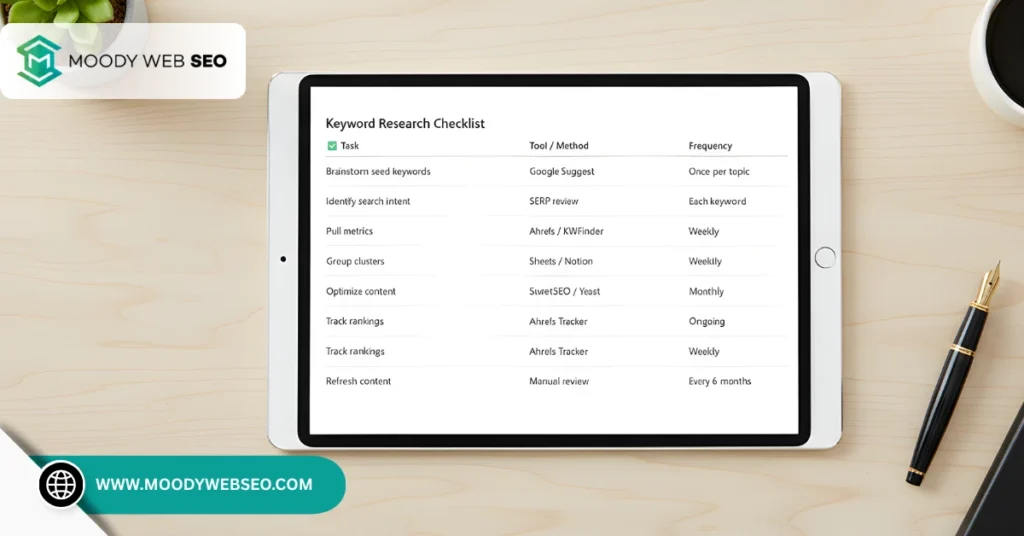
| Task | Tool / Method | Frequency |
| Brainstorm seed keywords | Google Suggest | Once per topic |
| Identify search intent | SERP review | Each keyword |
| Pull metrics | Ahrefs / KWFinder | Weekly |
| Group clusters | Sheets / Notion | Monthly |
| Optimize content | SurferSEO / Yoast | Ongoing |
| Track rankings | Ahrefs Tracker | Weekly |
| Refresh content | Manual review | Every 6 months |
Pro Tips for 2025 Keyword Strategy
- Focus on E-E-A-T: show experience with examples, screenshots, or data.
- Use AI clustering tools for smarter grouping.
- Optimize for mobile and voice search intent.
- Explore YouTube suggestions and Reddit threads for hidden keyword opportunities.
- Prioritize intent and conversion value over high search volume.
Common Mistakes to Avoid
- Stuffing keywords unnaturally
- Ignoring user intent
- Skipping SERP analysis
- Targeting broad, high-competition terms
- Failing to update keyword lists regularly
Final Thoughts
Keyword research is the blueprint of SEO success.
Do it right, and you’ll know exactly what to create — and how to rank for it.
With smart use of tools, intent analysis, and semantic optimization, you’ll stop chasing trends and start setting them.
Top Takeaways to Do Keyword Research Like a Pro
- Keyword research is the foundation of every SEO strategy.
- Understand search intent before choosing keywords.
- Use tools like Ahrefs, Moz, and KWFinder to find low-hanging opportunities.
- Target a mix of short-tail, long-tail, semantic, and voice search keywords.
- Refresh your keyword strategy every 3–6 months.