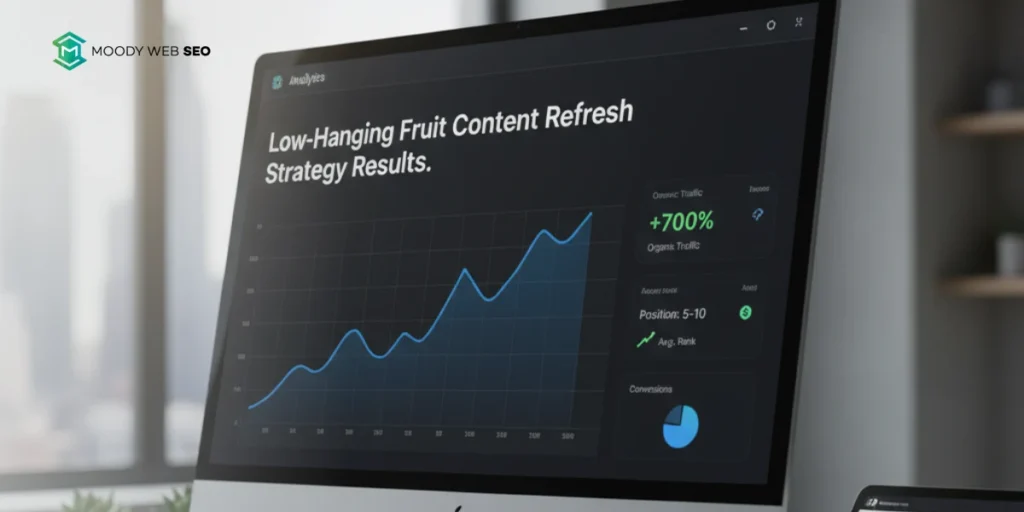
Ready to drastically increase website traffic without writing a single new blog post? This is not clickbait. Many businesses are leaving massive organic traffic on the table because they overlook an extremely quick, simple, and entirely free SEO technique for more traffic. I call this method the Low-Hanging Fruit Content Refresh.
This technique focuses on optimizing content that Google already trusts, but which is just outside the top results (positions 5-15). One client used this process, and their rankings “not only shot up in a matter of weeks but they also snagged some featured snippets for their target keywords”. If you can dedicate just a few minutes, you can realistically see a 7x increase in traffic for targeted pages.
What Is the Low-Hanging Fruit Content Refresh?
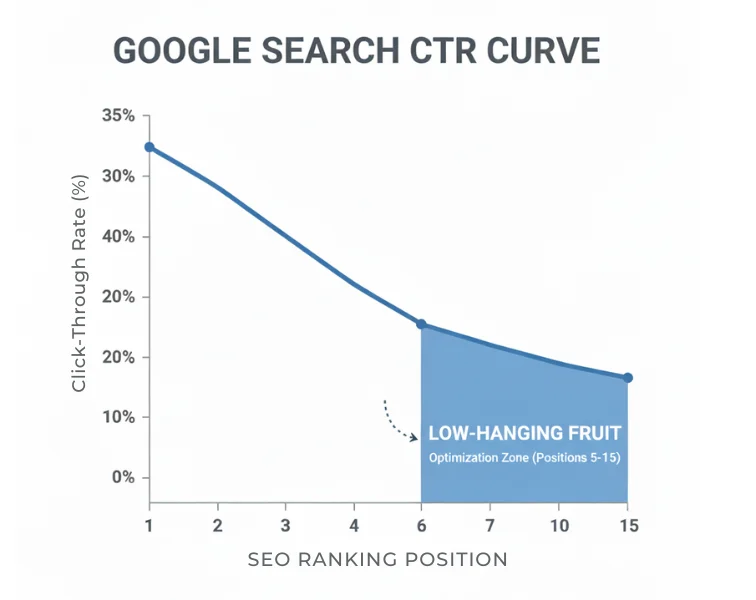
The Low-Hanging Fruit Content Refresh approach targets keywords for the pages that rank between positions 5 and 15. These positions are often referred to as ‘low-hanging fruit’ and are prime selections for optimization, as they already attract some traffic but can be improved in their SERP position with minimal effort.
Target the Goldilocks Zone: Position 5–15 in Google Search Console
The core principle of this strategy is simple: attack the competition where they are weakest just before the click-through rate (CTR) cliff.
Pages ranking in positions 5 through 15 are your low-hanging fruit because they:
- Have Trust: Google already ranks them on the first page, indicating content quality.
- Need a Boost: Position 1 has a massive 45.8% CTR, but by position 5, the CTR is significantly lower.
- Offer Highest Leverage: A page moving from position 10 (1.42% CTR) to position 5 (6.8% CTR) can see its traffic 7X!
The first step is to identify these pages using the free Google Search Console tool:
- Go to Performance → Search Results.
- Ensure the Average Position box is checked.
- Set a position filter: Greater than 4.9.
- This reveals all keywords ranking between position 5 and the rest of the SERP.
The Low-Hanging Fruit Content Refresh targets efforts where keyword position improvement, a CTR boost, and the return on investment (ROI) are achieved the fastest.
The Three Kings of SEO: Optimizing for Featured Snippets
Once you’ve identified a page in the 5-15 range, the next step is to choose your target keyword ideally, the one with the highest clicks/impressions that best encapsulates the page’s scope.
You must then add these Target Keyword into main areas of the webspage. What SEO’s professionals call The Three Kings:
- The Title Tag: The clickable headline that appears in the SERP.
- The H1 Tag: The main, on-page headline (usually the post title).
- The First Sentence/Paragraph: The very first line of your body copy.
Google relies on these three spots to quickly detect the true topic of your page. Failing to use your target keyword here is “likely confusing the Google algorithm and you’re likely leaving lots of clicks and lots of impressions on the table”.
Practical Application: How The Three Kings Work
This is not a theoretical concept; it’s a fundamental signal Google looks for. You can see this optimizing page for google featured snippet strategy everywhere:
- Investopedia Example: A search for “what is the stock market” reveals Investopedia as the top result. They use the key phrase in the URL, H1 tag, and title tag. Crucially, they also provide a clear definition right off the bat in the first paragraph, which helps them secure Featured Snippets.
- Wix Example: A page ranking for “how to design a logo” has the full keyword phrase in its URL, H1 tag, title tag, and the very first paragraph of the body copy.
The lesson here is to prioritize clarity. Get straight to the answer in your opening paragraph to signal relevance to Google and the user.
The Quick Content Fix and The Long-Term Play
As an SEO, I initially performed this quick “three kings” technique across a client’s pages, which had “mediocre content”. The result: “their rankings shot up, they got some featured snippets, and it bought us enough time to then go back and do a full content refresh“.
Step-by-Step Implementation
- Identify Low-Hanging Keywords:
- Access Google Search Console.
- Navigate to the Performance report.
- Apply a filter for positions between 5 and 15.
- Sort by Clicks to prioritize keywords with existing traffic.
- Select a Target Keyword:
- Choose a keyword that aligns with your content’s intent and has a reasonable search volume.
- Ensure the keyword accurately represents the page’s content.
- Optimize the Three Kings:
- Edit the Title Tag, H1 Tag, and First Paragraph to include the target keyword.
- Maintain natural readability; avoid keyword stuffing.
- Request Indexing:
- After making changes, use the URL Inspection Tool in Google Search Console.
- Submit a request for indexing to expedite the crawling of your updated page.
- Monitor and Iterate:
- Track the page’s performance over time.
- If rankings don’t improve, consider further content enhancements or addressing potential issues like keyword cannibalization.
The Advanced Optimization Step
If you perform the low-hanging fruit content refresh and still see no change after a few weeks, it’s a sign that your content quality needs a deeper check. Your next step should be a full on-page optimization review, focusing on:
Matching SERP Intent: Your page intent (e.g., a product feature page) must match the Search Engine Results Page (SERP) intent (e.g., informational definition). If the SERP is filled with “What is an IDE?” articles, your features page will not rank.
Studying the Top 3: Analyze every element of the top 3 results—word count, H2s/H3s, charts, images, and expert quotes. Your content must be just as good, if not better.
Why It Works
Optimizing these elements helps search engines better understand your content’s relevance, potentially improving rankings. Additionally, aligning your content with user intent can increase click-through rates (CTR), leading to more organic traffic.
Conclusion
The low-hanging fruit content refresh is your go-to first move for a massive, immediate jump in organic traffic and conversions. By using Google Search Console to target pages in the 5-15 position range and strategically applying the Target Keyword to The Three Kings, you maximize your organic reach. Implement this free seo technique for more traffic today, and start seeing significant results in a matter of weeks.